For an analytical brain, listening to the thunder may reveal more secrets than years of science research.
A.H. (yeah, this is just me being a smart-ass)
FINDING THE PARADOX
In my previous post I tried to explain, in simple (as I fantasized) words: why Einstein came up with his Special Theory of Relativity and what it is about. And, if you recall (assuming you read it), I promised to discuss some big problems which necessary follow from treating its majesty: Time, in such careless manner, I may say.
First, I have to mention, that there are many well-known paradoxes, which the theory advocates tried to explain with somewhat dubious explanations. Among those: the twin paradox I mentioned before, or the so-called: Trouton-Noble paradox, which is related to another ether-dismissing experiment, not surprisingly called: “Trouton-Noble experiment“. If the word: “another” confuses you, read my previous post, where I briefly describe the most famous ether-proving-but-proved-to-be-disproving experiment, called: Michelson–Morley experiment, which I took the liberty to abbreviate to: “M&M” for shortness and for fun… And, stop bugging me, just read my previous post, would you?
I’m not going to repeat these paradoxes, and rather describe a better one: more obvious and, in my invariably humble opinion, more difficult to dismiss.
Now, you may ask: why would you try to find contradictions in the theory, instead of just providing a credible explanations to the ether-disproving experiments? Well, first of all, I’m going to do both: the former in this post, the latter in the next one. Second: proving that Einstein’s theory can’t be correct, opens a see of possibilities, and honestly, I’m not necessarily advocating the existence of the ether, in conventional sense, but, whatever my own theories are, they would be, in Occam’s Razor sense, more plausible than, putting it simply, impossible ones.
OK, let’s get back to the example from my previous post with me and Greg having fun with relative motion. Here we are again (I’m the one in amazing blue colors), but this time I’m moving in opposite direction: towards the light source. Alternatively, you can imagine that I’m going in the same direction but the light is on the opposite side of me. I’m just saying this, so you don’t bug me with stupid statements like: “it’s different because you’re moving in different direction”.
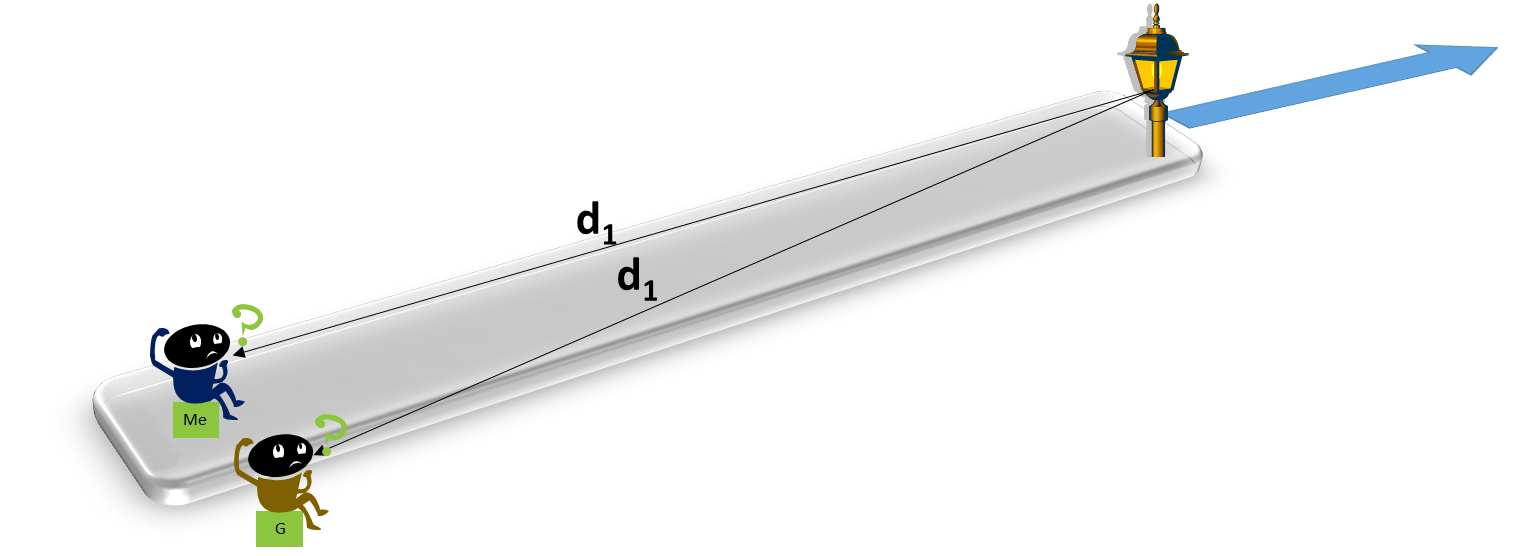
Now, from Greg’s point of view, the light reaches me before it reaches Greg, like this:

Again, like I explained in the previous post, due to the relativity principle, for each of us, it takes the light the same time to reach us: d1/C. One more time: from my point of view the light reaches me in d1/C, because the light source and I are in the same Inertial Frame of reference (see my previous post on this), but from Greg’s point of view, the light reaches me within: d2/C, so from Greg’s point of view my time is faster than Greg’s time. Let’s pause here, take a breather, relax… Done? Good. Now, remember that, in my previous post, following similar line of thought we discovered that (again from Greg’s point of view) my time (d2/C, or what we called: t2) was slower than Greg’s time (t2 > t1), now, by moving the light source on the opposite side of me, we discovered that my time is faster than Greg’s time (t2<t1).
I hope you’re not imagining that moving the light source from one end of the platform to the other can actually change the flow of time in this manner; if you do, just let me know, and I, just for you, will install two light sources on both sides of me, then I’ll move by my friend Greg, sitting on that stupid square, one more time. However you think about it, it turns out that my time is both: slower and faster than Greg’s, from Greg’s point of view. And before you start criticizing Greg’s point of view, remember that he lives in a free country (I’m not gonna tell you which country it is though) and has the right for his own point of view protected by that country’s constitution. And, as a matter of fact, my time will be both faster and slower than Greg’s from any point of view, if we properly apply this logic, but I really don’t want to rat-hole on this now.
So, in summary, we discovered that the Einstein’s relativity theory leads to the following inequality: t2 < t1 < t2, which you can use to instantly freak out any mathematician you don’t particularly like. And note, that, unlike the tween paradox, you can’t speculate that my direction and/or speed have changed during the experiment.
As much as I admire my newly discovered inequality, I like the equality: t2=t1=t2 (don’t ask me why I wrote t2 twice) better, mostly because it is, actually, possible. I think, if we are able to compare our watches without breaking that uniform relative motion, say: by bending the space or something, our watches would show the same time, unless these are bad, low quality watches, or the batteries are old, or we hadn’t synchronize them before the experiment, or hundreds of other possible reasons with the exception of one: time dilation.
APPLY THE SAME LOGIC AT WILL, IT”S FREE
You can (or, at least I can) use similar logic to show contradictions in any other illustration of the relativity theory. As an example, let’s pick another quite popular one. It goes like this: suppose that the light source (A) is attached to the moving platform, like before, but this time, the light is emitted upwards (perpendicular to the motion of the platform), reflected from the mirror (B) back to the light source. Sorry for a less entertaining picture, I got lazy this time. Just imagine me sitting there next to the little triangle and scratching my head. If this doesn’t work for you, let me know and I’ll draw you a pretty picture and decorate it with little red roses.
IFR, on the pictures, stands for: Inertial Frame of Reference. I am in IFR-1 and Greg is in IFR-2, but if it confuses you in any way, just ignore IFRs altogether, I’ll call it: “my world” and “Greg’s world” for your enjoyment.
 However, because the platform is moving, imaginary Greg, will see something like this:

The relativistic line of thought is quite similar to the previous example: since, from Greg’s point of view, the light travels longer distance, but the speed of light is the same from both: my and Greg’s perspective, the time must be flowing slower in my world, than in Greg’s world, again, from Greg’s point of view… Wouldn’t it be better if he hadn’t any point of view at all? For that matter: the only point of view I really care about is mine. But I digress.
OK, now, let’s destroy this fragile logic with the power of my counter-example: suppose there is one more light source on the platform, which emits light at an angle, equal to the angle C in the picture above. You should have guessed the outcome by now: for me and Greg, the light trajectories will look like on the picture below, respectively.
 Now, the roles have changed and the beam travels shorter distance for me than for Greg. This, according to relativity addicts, would imply that the time is faster in my world, and we’re back to the same paradox, namely that time in my world may be, at the same time, slower and faster, than in Greg’s world.
So, you would ask: if there is no relativity, how would the light behave in the presence of a propagation medium like ether (we agreed to call that medium ether or aether for now, but you may call it whatever you want: photon field, Higgs field, dark matter, I don’t care)? Well, in that case, the light will propagate with the speed of light (no pan intended) relative to the ether and so Gerg will see something like this:
Let’s remember this prediction of mine: we may get back to it in one of my future posts that will discuss an alternative to M&M’s Experiment approach to more definitively answer the question about existence of ether. Which reminds me: in the next post, I’ll provide my explanation of the results observed by M&M. Until then, I do appreciate any constructive feedback accompanied by scientifically valid argumentation.
Check out my next post: Listen to The Thunder (Part 3).
 Armen' s Random Thoughts
I find the concept of the “relativity of simultaneity” a fascineting subject for another blog post :). It leads to more logical paradoxes and I love it. Say, simultaneous events cause a verifiable event, e.g. Greg gets shot (not me, of course, but that little cheater); in this case, one of the refernce frames must be a winner, or else he’ll die in one frame but survive in the other, which, unless frames are in parallel universes, would lead to a very weird stuff happening here: having a friend who’s dead and not dead at the same time may be very unhealthy for my view of reality.
But then the frames can actually BE in parallel universes, in which case we’ll have two winners and infinite number of new possibilities 🙂
LikeLike
In the experiment with two light sources, you on a moving platform and Greg staying – the discussion you should have with Greg is not how long it took for a light to reach you, but
1) how far away were the lights. You’ll have some disagreement, but you probably agree that the distance was the same for left and right light source, so you and Gred might just put this question aside,
2) which light was turned on earlier? Greg is staying, so he might trigger the lights and then insist both lights were turned on the same time. In this case you might accuse him of cheating, as he obviously (from your reference system) turned the light you are moving towards earlier!
As you see, it will be more interesting discussion, with accusations of cheating and might cause some violence. I hope you know Greg long enough to avoid it!
LikeLike