When you’re dropping rocks in the pool, you should watch the circles on the water, otherwise, you’re just wasting your time.
Kozma Prutkov
PREFACE
This post is 40 years overdue, that’s how long it took me to find courage and write about physics, in other words: about things I’m not supposed to understand (being a software engineer). And perhaps I don’t, but I’m still in a blissful ignorance about that. I guess it’s about time for somebody (preferably a physicist), tell me off and point me to my rightful place in an office cubicle (I’m kidding: I have a personal office) and, at least 100 miles away from the nearest telescope.
It’s not like they didn’t try before: I shared my amateurish thoughts with several Physics PhD dudes, hoping for an instant revelation of my stupidity, but, regretfully, most of the time their telling me off sounded something like: “There must be an explanation, but I don’t remember it now, go read this”. I read this, and I read that, and more I read, stronger was my feeling that those who may be able to point me to my mistakes are locked somewhere in a government secret facility and are banned from communicating with the outside world. Hopefully, these several posts will reveal the last few who are still at large (just doing my duty: helping government to get the bastards 🙂 ).
Of course, the other possibility is that I’m right, however impossible it may sound, which means that lots of theories developed after the famous (or, perhaps, infamous) Michelson–Morley experiment will need to be revised.
OK, I know what you think: “Oh please, not again: not another anti-relativity freak. M&M (that’s how I want to call Michelson and Morley, hopefully, I don’t infringe on any trademarks here) experiment has been verified million times already, there are experiments that clearly demonstrated the evidence of the time dilation (I’ll explain what it is later), everything seems to fit so nicely into the framework, give us finally a brake, will you?”. Well, I’m not so sure about: “nicely fit” aspect of it, but, essentially, you would be right: I am going to, among other things, deal with Special Theory of Relativity (you’ll see me calling it “the theory” “relativity”, “Einstein’s theory” and bunch of other things, hopefully you’ll know what I’m talking about ; if not: give me a call), but I’ll first present the history and the gist of it (that’s what this first post will be about), and then, in future posts I promise to address all your concerns, namely: why I think that the relativity theory can’t be valid, why the M&M and similar experiments produced “unexpected” results, why the “evidence of time dilation” has nothing to do with time dilation, and, depending on how long I can keep writing, some other aspects of scientific speculation.
What I’m NOT going to do is: explain why it is called “Listen to Thunder” pretending there is some mystery in it; at least, not in this first post.
We’ll start looking into Einstein’s Special Theory of Relativity (there is also a General Theory of Relativity, which is even weirder, but somehow makes a bit more sense than special one. We may or may not address it later.), but before explaining the theory itself, let’s first understand why would anybody come up with the weird ideas like: when I move relative to my friend Greg, to him my watch ticks slower than his, but, what’s even weirder: to me, Greg’s time clicks slower than mine, and, according to scientists, there is no contradiction (aka: twin paradox), since there is no way to verify that. Actually, they say, that if we meet again to compare our watches, we may not see any difference, because, in order to meet again, we would need to change the direction and speed and then: gotcha! we broke the rule of being a so-called: Inertial Frame of Reference (in simpler terms: moving with a uniform speed, in a straight line), and so: “Nah-nah-nah-nah: you can’t prove there is any contradiction”. I wonder, what will be the “scientific” explanation if we manage to bend the space (perfectly possible as an inference from the generalization of the same theory) and meet while still moving in the same speed and direction…
Sure, let’s go with that, but wait… how about that evidence for time dilation when atomic clocks from fast moving airplanes were compared and the time difference was “just as the relativity theory has predicted”? It’s easy to show that whatever the movements and speed of dude A is relative to dude B, exactly the same movements and speed (though in opposite direction) would be of dude B relative to A. I do have a better explanation for the time difference they observed, but we’ll save it for later. Right now, let’s talk about the time when the world was much simpler place and time, distance and mass didn’t depend on speed or gravity.
SOME HISTORY
I must note here, that, any decent, self-respecting scientist, would never use a layman words like: “speed” in a serious paper. A failure to use the only proper scientific term: “velocity” could get you forever banished from the scientific society. But, since what I’m writing here can’t be considered a serious scientific paper, and I’m definitely not a decent, self-respecting scientists by any measure, and, after this post, I will, of course, be banished from scientific society anyway, I’ll just completely disregard all this formality and, in general, do whatever I want here.
But I digress… Where were we? Oh yes: good old times. By the last decade of 19th century, the world was totally awesome. Everything made sense and people were reasonable. Nobody rushed anywhere and everybody had plenty of time. Well, with the exception of the factory workers who worked 16 hours a day, but they should blame themselves: they should have learned to add and subtract numbers and become scientists. So, where was I? Oh, yeah: that was the golden age for scientists. First of all, in most places they weren’t burned at stake for their ideas anymore, and they didn’t have spreadsheets or calculators. Stress at work was like: “here, you need to add these 100 numbers together, remember we’re on tight schedule and I need the answer in three months max, can’t wait any longer than that. If you can’t do that you should tell me now.” That would generally leave some time for peaceful contemplation.
The scientific research was about to end: everything was known, all laws of nature were discovered and the scientists were finishing the last chapter in the book of science. Well there were like couple of exceptions, some minor things, which were also known, just needed a bit more evidence. Like this one called: luminiferous aether. You see, the visible light, was behaving exactly like any other known wave, such as, for example sound waves or waves on the surface of water. The waves propagate through media: for sound it’s the matter, pretty much any matter which has those atoms and molecules in it. The sound source pushes some molecules, which, in turn. push nearby molecules, which push their neighbors, etc, until all these pushing around reaches your ear and pushes a sensitive membrane there which your brain interprets as sound.
Water waves need water, gravity and somebody like me who loves throwing rocks into the water. Well, pretty much anything that pushes the water, would work. With water, the pushing around is very much like with sound, but it happens mostly in vertical direction. If you push down at water (you can safely try this at home), the displaced water will displace water around it, which will go up, then pulled down by the gravity, displacing more water around it, etc.
Since 17th century, scientists were finding more and more properties of light, which were so similar to other waves, so, scientists very much agreed that light is a wave too. Now, all waves need a propagation media, in other words: particles that push or pull each other in some way, and so it was concluded that the entire universe is filled with substance scientists call luminiferous aether, and I’m going to call it just ether to save you from the pain of mentally pronouncing: “luminiferous” every time (but, in truth, saving myself from the pain of copy/pasting it over and over again).
And so, in 1887, Albert A. Michelson and Edward W. Morley (M&M, remember?) conducted an experiment to find the evidence for the ether. Their logic went like this: since the earth is moving through the space (read: ether) at a high speed, and the speed of light is constant relative to the ether, then, relative to earth, the light should go with the speed adjusted by the speed of earth relative to ether. For example: if the beam of light is send opposite to the earth’s movement, it’s speed relative to earth would be faster than if the beam were traveling in the same direction with earth. It’s like you’re riding a train and see a bird flying outside; if it flies in the opposite direction (which, by the way rarely happens: those birds seem to always chose to fly with the train and at the same speed, perhaps hoping to get food or something), it would seem to go by so fast you’d hardly notice, whereas, if they fly with the train, you may be enjoying bird’s company for a while. Of course, for best analogy we should have assumed that the train moves a bit faster (or slower) than the bird, which rarely happens, so, I guess my example sucks in that way, but you get the point, right?
In reality, of course the direction and the speed of the earth is a bit tricky subject. Consider this:
- If you’re standing at the equator, your speed due to earth’s rotation is about: 1000 miles per hour
- Earth’s moving around the sun with the approximate speed of: 67,000 m/h
- With solar system, around the galaxy: ~490,000 m/h
- Galaxy moves towards something scientists call: “Great Attractor” (dunno what it is, and it doesn’t matter…) with the speed of about: 2,227,273 m/h
M&M didn’t really know all of that (I mean: they knew some of that, but not ALL of that), and they didn’t care either. They built a contraption, which basically split a beam of light into two beams, and redirected them in a way that they traveled perpendicular to each other (if you don’t know what ‘perpendicular’ means, stop reading right now: the cows need to be milked and the football game is about to start). They made it such, that they could rotate the device whenever they want and make measurements in any and all orientations of the device, and so they believed that they had to observe some difference in the speed of these light beams in, at least, some positions of the device… Actually, that thing they built was floating in a pool filled with mercury for smooth rotation. I always wandered if either of M’s suffered from Mercury poisonous vapors afterwards, but never cared to confirm…
Sufficient to say that, if they would find the evidence of the ether, the Special Theory of Relativity wouldn’t exist and I wouldn’t spend time right now in the search of words to describe it. But, whatever they did, the difference they were looking for was much smaller than what their calculations have predicted.
M&M really freaked out, texted all their friends and family, posted results on the Facebook and received few thousand ‘likes’ in the matter of hours. Scientific community scratched their heads trying to find a good explanation. But no matter what theory they would come up with, it didn’t explain all the known observations, that is: up until Einstein came up with his relativity thing.
So, to summarize: light moves through ether and by ether. However, regardless of the speed with which the light source and the observer move through the ether, the time it takes for the light to reach the observer doesn’t change, it’s like the ether moves with the earth, which is, by the way, one very popular theory (called: drag hypothesis) attempting to explain the M&M results. We’ll come back to it later. For now, let’s just say that, there were some observations which didn’t seat well with the drag theory, and so the supporters of the hypothesis had to eventually shut up.
EINSTEIN AND HIS GREAT ENTRANCE
Then there comes that Einstein guy and says: there is no ether. And, if there is no ether, how do you know if earth is moving? Maybe earth is still, and the rest of the universe is moving around us and in all other directions I listed above? Hmm… isn’t that what everyone was saying before Galileo came along with his rotating earth nonsense? OK, let’s not get carried away here: Einstein didn’t say Galileo was wrong, as a matter of fact he employed Galileo’s principal of relativity to explain the behavior of light observed by M&M.
Here’s the gist of what Galileo was saying about relativity: suppose you’re in a train, which moves with constant speed and in a straight line (something he called: Inertial Frame of Reference, or IFR). And, just to make it more illustrative, suppose the windows are closed and you can’t see outside. Galileo claims, that there is no way you can determine if you’re moving or standing still: everything within the room will behave exactly the same as if you were not moving relative to the earth. Now, even, if you open the windows, you may think the world is moving and not you. Einstein claimed that the light is no different: in any IFR (let’s call it a train or a moving platform, I don’t want to freak you out) it behaves like the train is not moving… But here’s the catch: in Galileo’s world, whatever was happening in that train we mentioned, from outside world would look quite different, than from the seat in the business class attached to the train (now, let’s assume the train is made of transparent glass and, outsiders can see what’s going on inside… Why don’t we make trains like that really? Wouldn’t it be cool? And imagine how much our kids could learn about physics? OK, I suppose not, but it’ll still be cool). Where was I? Oh yes: looking from outside, everything that moves inside our transparent train will move with the speed, which is the sum of the train’s speed and its speed relative to the train. With light, it’s quite different though: it’s been observed before that the light emitted from a moving object has the same speed as from stationary object (all of this relative to a stationary observer, which is a relative notion by itself, blah, blah, blah… I’m not going to explain all of this using mathematically precise “scientific” language, or I may bore you to death, if I haven’t done it yet…). Moreover, according to Einstein’s theory, the speed of light relative to any IFR (grrr.. can’t avoid it, can I?) is the same and nothing in the universe can move faster than the light in vacuum. That created rather paradoxical situation, which I decided to explain with an example (it’s my blog, I do whatever I want here, ok?).
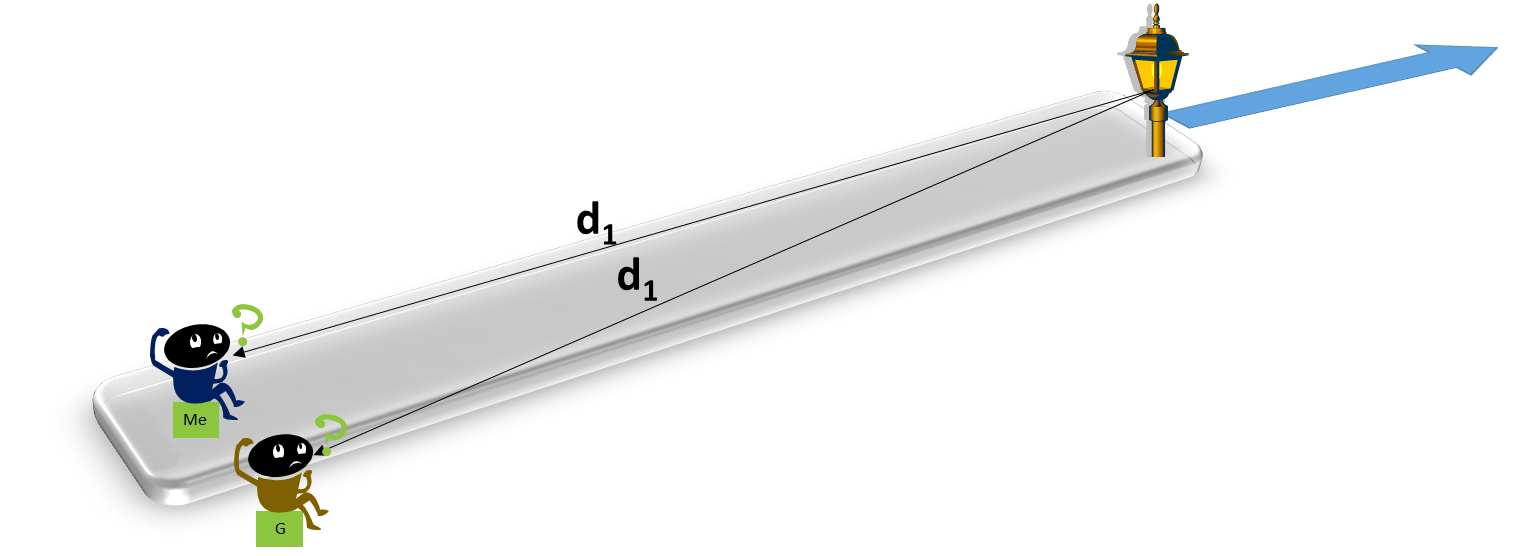
OK, suppose there are: my friend Greg and I, and I’m sitting on a moving platform. To keep things simple, just assume for now that, in my examples, whenever I say anything about motion or lack of it, it’s all relative to the earth. This just to calm down all those pedantic “precise language” maniacs…
Anyway, here we are on the picture (I’m in dark blue overalls):

Aren’t we cute? I think Greg has no sense of fashion: all these tasteless colors, you know… And that cube with the pretentious letter “G”, like he couldn’t just write his name. Sometimes, he just drives me crazy!
Yes, about the light. Suppose that light on the moving platform, when it turns on, it is at the equal distance (oversimplification: the relativity would make the distances and things happening “at the same time” also speed-dependent, but this doesn’t change the essence of the illustration and conclusions) from each of us, like on that picture above, but I’m moving, while Greg is not. Now, according to Einstein, the light will reach me in the same time, as if the platform wasn’t moving at all, however, from Greg’s point of view the light reaches him before it reaches me, since while the light was traveling from that lantern to him, I have already moved a bit further, like on this picture:

Now, as I mentioned above, it was known that the speed of light is the same whether it is emitted from a moving or stationary source (just the frequency changes, also known as Doppler Effect), which means that, to Greg, the light reaches him in the same time as, to me, it reaches me.
OK, this is the most important part, so I’ll say it again: if I had a super-precise watch and had some magical way of timing the time it takes the light to reach me after the lantern goes on, it would take the light some time, let’s call it: “t1” (also known as: d1/C, where ‘C’ is the speed of light, but it’s unimportant). If Gerg measures the time light takes to reach him in the same way using some magic and his super-precise watch, his measurement will, according to Einstein, show the exact same time: “t1”.
Now, Einstein got all excited and also posted his ideas on the Facebook, which caused some of his more intelligent friends and fans to think he’s lost his marbles, and few more inquisitive ones replied to Einsteins post saying something along the lines: “No ether? Fine, good riddance, but great Einstein, aren’t you missing the fact that to the moving guy (that’s what they were calling me in those times: “the moving guy”), the light actually travels a longer distance (d2), if it reaches him in the same time, are you suggesting that the light travels faster than the speed of light?” Einstein, scratched his head for few minutes, but he wasn’t the guy to be defeated that easily, his next post went something like this: “no, the speed of light is the same, but the TIME for the moving guy flows slower…” So, in other words: while for me (the moving guy, remember?) it took light t1 to reach me, from Greg’s point of view, it took a bit longer: d2/C, to be more precise. Let’ call that t2.
Cool right? And a great name for the phenomena: “time dilation”, wouldn’t hurt either. Well, it would be cool, if it hadn’t introduced worse problems than it was intended to solve. But, I’ll talk about those in my next post on this topic.


 Armen' s Random Thoughts