One More Time About Relativity…

I just thought that my long explanation in these 7 posts, including the summary, might be a bit confusing; so I’m making another attempt to seal it with even terser summary. Here it is:

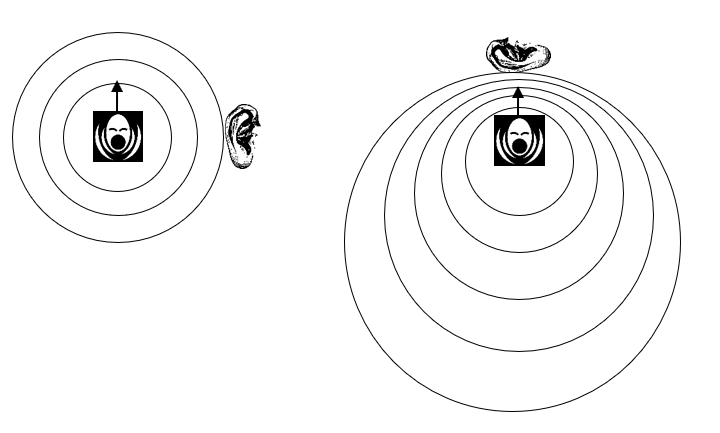
The illusion of time dilation is nothing more than Doppler effect: if two observers are moving away from each other, each of them will see the events from the other observer as happening slower, when they turn around and start moving to each other, the events/time of the other observer will seem to happen faster, and when they meet their theoretically precise clocks (not the atomic clocks also affected by the doppler effect – don’t start again on that “evidence” of time dilation) will show exactly the same time.

That’s all I wanted to say. It was good to get that out of my chest…

The Summary

For those who are not interested in reading all of those 6 previous posts in this category, or those who may decide to read those after reading this summary, here is the brief summary of those. (All these puns and wordplay are totally intended).

Ok main point I tried to make:

  1. The main conclusions made by Einstein based on Michelson/Morley experiment may not be correct (as Einstein suspected himself) and the experiment results can be explained by gravitational drug theory (GDT).
    • The standard argument against GDT can be disputed (you’ll actually need to read the long version for this)
  2. The media allowing propagation of electromagnetic waves (or aether for the lack of better term) exists and may account for the Dark Matter
  3. The time dilation is an illusion created by the time differences observed when observers register events reaching them by means of electromagnetic wave, and are determined by the speed of light moving through aether.
    • Read details describing paradoxes resulting from the assumption of time dilation
    • The experiments conducted with two atomic clocks can be explained by Doppler Effect which atomic clocks will be prone to, under assumption of aether and constant (other things equal) speed of electromagnetic wave relative to aether.
  4. A side observation: aether, can contribute to light attenuation, which would alter the evidence of acceleration of universe expansion.

If interested to read more of my blubbering on these and some other topics, please dive in and read the 6 posts which I, quite unfortunately, titled; “Listen to The Thunder”.

Listen to The thunder – Part 6

If you can’t explain it simply, you don’t understand it well enough.

Albert Einstein

I haven’t said anything on this topic for a while, and so I felt an uncontrollable urge to grumble a little more. As opposed to the previous monologues (weird to call those: “discussions” as I’m talking to myself and nobody disagrees or even listens), especially:  Part 1, Part 2 , Part 4 and Part 5, this part can be read separately. All you need to know is that in previous parts I was ranting about Einstein’s theory of relativity and the modern physics in general.

This time, I’m going to talk briefly (I hope) about early (pre-Michelson–Morley experiment ) roots of the relativity, but not as early as Galileo’s principal of relativity, in other words: about the time when the s@#t happened. The latest fad at that time in scientific circles was the idea that, in addition to the three dimensions (implying the rectangular, also called ‘Cartesian’ system of coordinate), which can be used to pinpoint any location in the observable universe, the fourth dimension of time should be considered too for registering the change, or for whatever other reason (one may only wander why wouldn’t they also add some other dimensions, like density, amount of radiation, etc. to screw things up even more).

So far so good: cool idea. Now, to convert this idea from purely philosophical to scientific, they needed to write it down as some mathematical equation, because that’s what scientists do to make things look scientific and publish their papers. So, if in the good old 3D world, any location could be described by 3 coordinates as a simple summation of coordinate vectors: X, Y and Z, in the new 4D world the time should be somehow crammed into this elegant equation. Unfortunately, trying to do so proved tricky, and all the elegance has been lost. The problem is that you can’t just add the time and the distance together, as those are measured in different units. After some head scratching, scientists arrived at the ‘aha’ moment. Basically, they figured that the easiest way to get distance out of time is to multiple the time by velocity (which also, conveniently, makes this a vector, meaning: adds a direction). Great! But… wait a minute… velocity of what? Well, the obvious thought would have been to use the velocity of the 3D location change, which you are trying to measure, relative to the center of coordinates (the point with X=0, Y=0, Z=0). That would have made a lot of sense, and maybe even somewhat preserve the elegance of the original equation, but the scientists don’t choose easy paths. “Let’s take a speed which we believe is constant” – they thought, and if that’s the case why not take the most famous one: the speed of light in vacuum (this is not the device you use to clean the carpet)? “Anyway, the fastest way we can observe the change is with speed of light” – they thought (which,eventually, proved to be untrue, but scientists are stubborn people and they don’t give up on their beliefs easily). Done. And thus, the s@#t happened. Now, the formerly pretty equation looks pretty much like this (coordinates are vectors): L = X + Y + Z + c*t. Here, the ‘L’ is the location in so-called: ‘space-time’, X,Y,Z are familiar coordinate vectors, c – is the speed (apologies: velocity) of light and t – is the time.

Now we are in the world, where whenever you want to actually measure relative change in location, you have to add another member: v*t, where v is the velocity of the change. As a result everything, including time and distance, depends on the v/c – the relative velocity of change with respect to the light velocity. Voila: time dilation!

From all of this comes a simple observation that all the predictions of the special theory of relativity are, in fact, not what actually happens to the time or distance, but rather what it seems to happen, if we observe the changes through the changes in light (or, more generally: changes in electromagnetic radiation we are able to register). Here: I’ll give you an example. Imagine a wall clock (let’s say it’s an electronic clock with a bright digital dashboard. The type of the clock doesn’t matter, of course, this is just to help your imagination and because I like it that way), which just turned to 3:00. For a person who sits right next to the clock the observation is almost immediate. She can look at her hand watch (I’m not being a feminist or sexists, it’s just: men don’t make a big fuss out of not using “gender neutral” nonsense, and it’s annoying to constantly use “he or she” and similar wording. So, all the observers here are females.) and observe that exactly one minute later, according to her watch, the wall clock will turn to 3:01. Now suppose that the wall clock is visible from outside (say, it’s on an electronic display on the building wall and our observer girl is enjoying her coffee in a nearby café). At the moment, when the clock displayed 3:00, the light from the digital display started to move with the speed of light into the universe. Now imagine some observer (girl 2), who is 5 light-minutes away from the clock and has really good optical equipment. She will observe the clock turning 3:00 at exactly 3:05 on her watch (assuming the watch and the clock are in sync, though this doesn’t matter). Also note, that the light from the watch displaying: 3:01, would have already reached 4 light-minutes from earth, 1 light-minute away from the girl 2.  Now also suppose that girl 2 moves away from the earth with a really high speed, say with the speed, which equals 50% of the speed of light. This means that she will be at 6 light-minutes from earth in two minutes (since she covers just 1/2 of a light-minute per minute), so her watch will display 3:07 when she gets there. However, in two minutes, the light from the clock, displaying 3:01 will reach that very point at that very moment (remember: it was 4 light-minutes from earth, and in two minutes, it has to be at the distance of 6 light-minutes from earth). And so, to the girl 2, it will seem that her time goes 2 times faster than the time she observes from  earth, while to the entire modern scientific community it will seem that a time dilation took place.

In similar fashion, you can easily explain other predictions of the special theory of relativity. E.g. the theory predicts that, if something moves with the speed of light from you, the time there stops completely. Well, suppose the girl 2 moves with the speed of light away from the clock, meaning the clock moves away with the speed of light from the girl 2. This means that if the girl observed 3:00 from the clock at some point, she will continue observing that time for as long as she moves with the same speed as the light from the clock showing 3:00. Similarly, relativity predicts that one can travel back in time if they move faster than light. Well suppose the girl 2 moves faster than the image from the clock. This means that she will start catching up with the previous images emitted from the clock, and that means, that, to her, it would seem that the time on earth goes backwards. The relativity of simultaneity and most other evidences of time dilation can be explained in similar fashion.

And so, it seems to me, that the whole thing is caused by some arbitrary choices made in the past. For a bit more detailed and technical monologue on the results of the Michelson–Morley experiment and other “evidences” of time dilation, please see my previous posts on this.

Thanks for listening.

Listen to The Thunder (Part 5)


If your experiment needs statistics, you ought to have done a better experiment.

Ernest Rutherford

SO, YOU HAVE THE PROOF, YOU SAY…

If you haven’t read my previous posts on this topic, this may seem to you a delirium of an incompetent fool, which it very well may be, but still, do me a favor: don’t read this unless you read Part 1, Part 2 and Part 4 of this series of posts (while you’re at it, what the heck, you can also read Part 3, but I guess that will be asking too much of you…).

As promised in the previous post, I’ll go ahead and dismantle some of the more popular “evidence” of time dilation, so often referenced by the bunch of very important folks, who call themselves: “scientists” (for the record: I have nothing against scientists, have total respect for them, but who says you can’t make fun of people you have total respect for? These folks are funny people themselves, that’s why I respect them).

The first, and the most touted one, is known as: “Hafele & Keating (H&K) experiment” conducted back in 1971, in which they compared the atomic clocks located on two airplanes flying one eastward and the other westward and yet another clock moving eastward with the mother earth (in other words: seating still on the ground). Before saying anything else about this measurement, I need to mention that the results of the experiment were flawed, to say the least: the results were far from what they were predicting, and so they decided to “correct” them before publishing, or, in simple terms: they lied about their results. Yet still whenever you ask a physicist or just a smart-ass with letters: p, h and d written after their name, more often than not, the answer is: “oh, yes, we have an experimental proof of time dilation from these two dudes… what were their names again? Hafting and Kafele or Halfling and Tatele, anyway, those two proved with certainty that there is a time dilation”. A bit more informed people, however, would point out that, after H&K experiment, there were other similar experiments and, this time, nobody seemed to confess that “corrections” were made to the results. Which is actually a good thing, because, as I’m about to show you, the results are completely inconsistent with relativity and, in fact, are good evidence for  the existence of what we agreed to call : “ether” for the lack of a better term. At least, that’s the plan.

Before doing that, however, I want to mention another alleged ‘evidence’ of time dilation of the same kind: the discrepancy between the atomic clocks in the GPS satellites and those on the surface of the earth. I’ll deal with all these “evidences” with a single blow, and, by the way, will provide some non-relativistic explanation to the “time dilation evidence” due to gravity (from the area saliently called: “General Theory Of Relativity”).

Let’s have a closer look at what these claims try to say. Let’s start with the planes experiment. The claim is that the clock on the plane flying eastward will go slower than the clock on the earth, which in turn, will go slower than the clock on the westward going plane. That’s because the former flies in the direction of the earth’s rotation and their velocities… sorry, forgot that we agreed to call this with a laymen word: ‘speed’ (not caring about the direction for now). So, as I was saying: the speed of eastward plain is earth’s speed plus plain’s speed, whereas, the speed of westward plain is plain’s speed minus earth’s speed, which, is a negative number because earth is moving faster than the plain. I read this and I ask myself (since nobody else hears me talking or really gives a damn, anyway…): relative to what? According to Einstein’s relativity, earth’s speed doesn’t matter at all in this case and both plains are flying with the same (approximately) speed relative to the earth and with the exactly same speed relative to each other. Thus, according to the relativity, the observations (and expectations of the H&K) are totally contradicting the relativity principles. Yes, we can see the difference with respect to the sun, when we fly east or west (the day lasts shorter or longer), but the control clock is not on the sun, it’s on the earth. Either I’m missing something, or that happens to the entire scientific community. Hard to believe the latter, but… Yes, i know: since the motion is circular, the frames of reference are not inertial, yada, yada, yada… This doesn’t change the symmetric nature of the experiment in earth’s frame of reference.

As a matter of fact, the discrepancy observed, better than anything else, suggests the existence of an absolute reference frame, or media, relative to which all the movements are happening, in which case we can safely add and subtract the veloc… sorry: speeds of the moving parts (like the earth and the airplane, but not the light: that one has constant speed with respect to the media, like all other waves do, more or less, especially when the wavelengths and media are the same… But I guess, I digress, and I do that with rhyme). Now, how would the existence of the ether explain the differences in the atomic clock measurements? I’ll tell you, right after I deal with the GPS satellite “time dilation” phenomenon, since the explanation is somewhat similar.

Indeed, the GPS time has to be corrected as the atomic clocks on the satellite divert from those on earth and the relativity sees time dilation as the usual suspect. In this case, there are two aspects though. The first one is the time dilation due to the satellite’s speed which is, again, claimed to be higher than the earth’s speed. Yeah… but the GPS satellites, actually stationary relative to the earth. Again, just like with H&K plains: the satellite moves faster that the earth relative to some absolute frame of reference, but not to each other.

The second aspect is related to the fact that, because the satellite is far from the earth, the gravity there is weaker and, “obviously”, the time dilation is observed, due to the postulates of the general theory of relativity. I did mention before that this flavor of relativity makes a bit more sense to me than the special one, not because I think there, indeed, is time dilation, but because gravitation produces interesting effects due to the fact that, because of gravitation, the ether is dragged stronger right above the surface of the earth and gets weaker as you move away and up, and, as I suspect, it might be more compressed down here than far up. It’s there, up at the satellite elevation, where Michelson and Morley should have taken their contraption and tried to detect the ether wind they were looking for. Maybe they even wanted to do this, but the nearest satellite at the time was the Moon, and they just gave up the whole idea…

So, whether there are airplanes or GPS satellites, in every case the differences in speeds seem to be mostly relative to some absolute frame of reference, and, if its majesty Ether (I’ll be writing it with a capital letter henceforth…) may be exactly that: because of the gravitational nature of the Ether drag, the GPS on high elevation would also “feel” some Ether wind compared to that close to the earth’s surface. And the wind may not just come from the satellite’s rotation with the earth, but also from the largely unknown speed, direction and trajectory in which earth moves as a sum of all the moving parts including the solar system, the galaxy, the cluster, and who knows what else. There are some who believe that all this mindless and pointless movements result in the Earth moving towards Constellation of Leo with the speed of 390 km/second (see this if you’re interested), but I’m not going to make any judgments about this.

Anyway, I suspect that, since I blamed the Ether wind for the atomic clock discrepancies, I might also be asked to provide some explanations and justifications to support the claim, meaning: reveal, to the unsuspecting world, the secret workings of Ether causing atomic clock disruptions. And that’s exactly what I’m going to do now.

The thing is that with any presence of movement relative to Ether, the atomic clocks may be not as precise as you may think, especially if the clock is moving with acceleration (or deceleration). To understand why, we should first understand how the atomic clocks work. I’ll have to simplify the explanation to the bare essence to keep you awake, but feel free to Google it yourselves, if interested.

Let’s consider the cesium atomic clocks, which considered the most accurate and which were used during the H&K experiment. In really, really simple words: there is a microwave frequency which resonates with the oscillations of the cesium atoms at exactly: 9,192,631,770 Hertz, which causes the atoms change their energy level, then those, excited, atoms strike a detector and so we know the frequency is absolutely correct. Well, something like that, the details are not important for this discussion, what’s important is that there are: a microwave and a resonance. And I’m not talking about the oven in your kitchen, though it also uses the electromagnetic waves of similar frequency to heat your breakfast. Many attempts to use the atomic clock for similar purpose didn’t make my breakfast more enjoyable (I’m lying, of course, I never tried to warm up my breakfast with an atomic clock… in reality, I did it with my lunch), but, when radiated at the right frequency, managed to excite cesium atoms, which, apparently, find the whole this resonance thing exciting. Get the pun? He-he.

Anyway, this works fine when the wave source and atoms are in the same Inertial Frame of Reference, or IFR (remember: we talked about this in my first post?), and, even if the entire contraption is moving with the high speed, and everybody else (not in the same IFR) feels it by perceived change in frequency of the microwave (Doppler shift, remember?), the cesium atoms don’t feel that because they move with the wave source at the same speed. That’s fine, until we introduce acceleration, also known as change in velocity (this time I won’t use the word speed, since the change in direction may matter too). Whenever the clock accelerates relative to the Ether, the atoms perceive the microwave frequency Doppler-shifted, which means that the atoms get excited at a different frequency than the microwave source emits, and so, the latter, in its blissful ignorance, ‘believes’ its frequency is exactly: 9,192,631,770 Hertz, but, in reality, it isn’t.

Now you would ask: where the acceleration comes from? Well, you might have heard about the universe expanding and doing that with constantly increasing speed, and that acceleration, according to the current scientific beliefs, is mind boggling, some galaxies moving away faster than the speed of light (that’s the artifacts of “space inflation”, which doesn’t care about such minor problems as light speed barrier, don’t want to go into that one here…), though, I personally have lots of doubts about this theory (see my other post on this), but whether it’s accelerating or decelerating, the speed change rate is likely relatively constant for extended periods of time, so the impact on, say, the GPS clock would likely be relatively constant as well, enabling it to apply constant correction to the time signals.

There is a delicate moment in this, that we need to understand: the orientation of the atomic clock, relative to the direction of acceleration, is significant for the time discrepancy amount and sign, however, if the orientation changes in a regular fashion, the discrepancy may be, on the average about the same. This is true, even if the change in orientation is completely symmetrical. I would hate to bore you with the formal proof of this point, just trust me on this, OK? At the very crude intuitive level, here’s the analogy: if your speed is 100 km/h, twice faster is extra 100 km/h, however, twice slower is just 50 km/h, so, if you move twice slower half of the time then twice faster the other half, on the average, you move faster. Makes sense? It doesn’t? I don’t care what you think, go find the formulas and see for yourself you pedantic lunatic! That’s it, I’m pissed off, and I’m going to end this post right now. Good bye.


Listen to The Thunder (Part 4)


I have had my results for a long time: but I do not yet know how I am to arrive at them.


Karl Friedrich Gauss

THERE HAS TO BE ANOTHER EXPLANATION…

As we’ve seen (or, at least, I’ve seen, not sure about you, folks) in my previous posts (especially part 1 and part 2 of this monologue, pretentiously called: “Listen to The Thunder”) the special theory of relativity presents some, obvious to my amateur logic, contradictions. In other words it can’t be true. Which means that the M&M (no, it’s not a candy: read my previous posts) experiment MUST have a different explanation, as well as the rest of “evidences” of time dilation. I’ll talk about these ‘evidences’ later in this or later posts.

I must confess that when I started with my first post on this topic I thought I had a good explanation of what the monocled men couldn’t explain more than 100 years ago and had to do with things scientists call ‘refraction’, or variation of the speed of a wave through media, which is dependent on the wavelength, and since earth moves with an incredible speed through the ether, the light beams from the M&M experiment going in orthogonal directions will have different wavelength due to the Doppler shift, etc. I liked this explanation because, as I thought, nobody thought about this before (at least that was my illusion). You may actually see how this thought also came after listening to the thunder, but it’s unimportant now since I had an enlightenment afterwards, noticing that if there is any difference in speed due to refraction, it will actually work in the direction opposite to what could embarrass the scientific world. And, of course, embarrassing the scientific world is a goal worth living for…

Anyway, I might have avoided embarrassing myself for the time being, but, of course, if one explanation is wrong there must be one or more other explanations which are right, or else this freaking universe has no idea what it’s doing and needs to make up its mind at some point.

There were quite a few attempts at finding more sensible explanation to the M&M measurements, I’m not the only one who noticed certain problems with relativity. One of more interesting alternative (to relativity) ideas, which stick with the notion of ether (this has nothing to do with the book of Mormon, by the way) or æther as the scientists would put it, was the Ether Drag Theory. To be more specific: the gravitational drag theory, because there is also the, for the lack of official term: “matter” drag theory ( hey there, well educated scientists: feel free to grumble about incorrect terminology. You’re welcome.), which predicts that the ether can be dragged by moving matter. There were some dudes, like this guy or this other guy who thought that the ether is somehow entrapped in the matter and, if the matter (say, air or water) move (say, with the earth), the ether moves with it. If that was the case, the M&M experiment results would have been quite expected, since if the ether moves with the earth, then there is no “ether wind” and the light should move with the same speed in all directions, as long as it’s not leaving the atmosphere. However, an earlier experiments (like this one), showed that ether is being only partially ‘dragged’ by matter. So, the purely matter dragging was quickly ruled out.

In contrast, the gravitational drag theory suggests that only a really big chunks of matter (like earth) with strong gravitational pull are able to drag the ether with it in any significant measure. This definitely sits better with both M&M and Fizeau (the guy who disappointed matter-dragging-lover bunch) experiments. This could have been a happy ending for this whole thing, but no: surely enough party-poopers came along to mess things up again. Their argument sounded like: “Stellar Aberration“, good luck reading this one.

STELLAR WHAT?

Let me try to explain (brace yourselves this might be a bit confusing): once upon a time (in 17th century to be more precise) somebody noticed that the polar star is observed at different angles in different times of the year. The difference was pretty small (40”), but the scientific world (though at that time they were called a bunch of weirdos without any sense of style) demanded some kind of explanation. Luckily, the heliocentric theory (in other words: the idea that the sun is in the center of the solar system and we’re happily revolving around it) was the biggest fad at the time, and the first thing the weirdos thought was: aha! here’s the evidence that the earth rotates around the sun, and so we see the stars under different angles depending on where we are in our orbit, or what the weirdos would call: parallax, just because it sounded so cool (though in Greek it simply means something like “change”).

The bunch-wide celebrations, however, came quickly to a halt, when somebody realized that the angle deviation appeared to be too big to be explained by parallax. The stars are simply too far away for the earth annual wandering to make that much difference in the angle of  observation. This puzzled those who were still interested until, some 50 years later the guy named Bradley came up with the theory of, you guessed it: Stellar Aberration, which scientifically speaking, is defined as: “the light does the same thing the rain does when you run though it: it starts hitting you at an angle”. This may sound ridiculous, but the idea has its merits. Let me first try to illustrate to you how this may make sense, before telling you why some people think it’s a bad news for the Gravitational Drag Theory.

OK, suppose that the light is a flow of tiny particles, called photons, just like rain is a flow of water drops. This may be a big simplification (or even untrue, which might be a good subject for a separate blog post) but it’s a good way of explaining stellar aberration… God! the word ‘stellar’ makes it sound like something the light must be really proud of… Anyway, imagine that the photon rain is produced by a star, far, far away, and, at the moment, located directly above your head, falls down on you, which means that, if you were not moving, you would see the star where it was when it emitted that light thousands of years ago (or perhaps millions or even billions years ago, especially if it’s not a star but a galaxy, which may look like a star to you, but that’s just because you don’t ware radio telescopes for glasses), that is: directly above your head. The star, or the galaxy may not even exist by now swallowed by a black hole or annihilated by some very advanced, intelligent, but apparently uncivilized life form, but we, in our happy oblivion will continue to see it’s light for many years to come.

Now, suppose, that you are moving in the direction orthogonal to the line connecting your head with the star’s location, when it was still alive that is, just like on the picture below.

PhotonRain1

Actually, that’s how it looks like for a side and stationary observer. What would you (in case you are not a coyote, feel free to replace the picture with your favorite representation of yourself. I don’t know who’s reading this, so I had to make some assumptions…)… what was I saying? Oh yes: what would you see, when you’re moving really fast (in reality you are not moving that fast, it’s the earth moving, of course), according to aberration proponents, would be something like this:

PhotonRain2

That’s because you are moving and photons are hitting you at a certain angle, just like rain drops. So, you would see the star appearing slightly shifted (right where I produced the gray star for your enjoyment) in the direction of your movement. Like I said, this is an oversimplified way of looking at how light works, but you get the idea.

Now, that we are well versed in the aberration thing, let’s see how it may be related to the Drag Hypothesis. Well, they (the weirdos, remember?) say, that, if the ether were actually dragged with the earth, the photons would stop falling at an angle and start falling again straight down like in the first picture, and there will be no aberration to be observed from the earth surface. That’s where I must stop and say: “what?”, and: “why?” Why would the wave do that? Why would it change it’s direction and all of a sudden start moving orthogonal to the direction in which the earth and the ether around are moving? That’s not what waves do, it’s like throwing a rock to a river, and the produced waves suddenly change their direction, break their favorite circle formations and start moving across the river in straight lines. If you don’t find this thought ridiculous, just try throwing rocks to the running water and watch (and don’t forget to think). Yeah, the waves will move with the water but they are not going to change their direction in such an arbitrary way. As a matter of fact, the moving ether may increase the aberration effect, actually ether may be the real cause for most of the observed aberration. It’s just like looking at the glass of water with a straw or a spoon in it: it looks like the straw is broken at strange angle. I may dedicate a separate post illustrating that the mechanism of such refraction is very similar to what would happen if the light hits a layer of ether moving at angle to the direction of light. Just trust me on this. In any case there is no freaking reason why the light would suddenly move in some specific and arbitrary direction, especially if the moving ether layer hits it in opposite directions at different times of the year.

I don’t know if I’m popping your bubble, but I don’t see the aberration disappearing with moving ether. If anything, the opposite must be true. And, even the light particles (photons) themselves wouldn’t immediately decide to change their direction either, they don’t seem to react that much flying through unimaginable distances through the space filled with infinity of photons emanated from billions of other sources and moving in all directions (I’ll save my rant about the duality of light for some other blog post).

You know, some people like to make too many assumptions about the properties of something they don’t even believe exists. it’s just like refusing that the newly discovered flying and fire breathing lizard may be called a dragon, because the dragons must have blue smoke coming out of their nostrils and be fluent in mandarin Chinese. But I digress… So, if, close to the earth’s surface, the ether moves with the earth, the light  radiating from a source that also moves in the same company will behave exactly as if nothing (except for the light waves, of course) moves at all. Thus: the M&M experiment is explained and the relativity theory is done for.

Well… almost. As I mentioned before, there is a collection of other “evidences” of relativity, which are much easier to dismiss, but this blog post is becoming too long and, I’m afraid, even the most devoted readers may give up; so, I’ll come back to these so-called evidences in later posts on this topic.

Adiós for now.

Listen to The Thunder (Part 3)

The important thing in science is not so much to obtain new facts as to discover new ways of thinking about them.

William Lawrence Bragg

ALL THOSE SPECULATIONS…

In my previous post, I promised to talk about M&M experiment, and how I won’t need special relativity to explain it to you. It might have been April fool’s day, I’m not sure right now, but turns out I was lying: I’m going to chat about something else now. Do not worry: I’ll get back to you on M&M experiment and other “evidence” of time delation later. I already started to write it and even found a great quote from Karl Freidrich Gauss to serve as an epigraph for it. It goes like this: “I have had my results for a long time: but I do not yet know how I am to arrive at them.” Nice, isn’t it? Anyway, I’ll do that in the next post, since it’s a bit involved and some of my argumentation may have a thing or two derived from the stuff I’m going to speculate about right now.

One problem I have with scientists of all times is that they always think too much about their current knowledge, it’s like: “yes sure, the previous generation of scientists made nasty mistakes, but now we know…” It seems like we never learn. Take, for example that new fad about the big bang, expanding and accelerating universe. You wanna know how they arrived at these ideas? With a lot of arrogance and over-confidence which often leads to, what I call: “tunneled thinking”… unless I’m wrong and they are right, but we’re not going to seriously consider that possibility, are we?

All started with Edwin Hubble, who was spending all his time looking at the stars and admiring their pretty colors. After watching them for a really long time, Edwin started to notice that most of the far away galaxies (he must be praised for discovering galaxies, by the way) are rather red in color. His first thought was that perhaps communists occupied far corners of the universe, and so he panicked a little, but then he thought about the Doppler shift and that was a great relief for the poor guy raised in a capitalist society. Luckily (or unluckily), scientists already new about the Doppler effect, that is: the property of waves to change their observed frequency depending on the speed of the wave source relative to the observer. If they didn’t know about it, they could have arrived at the correct interpretation, but no: the Doppler shift was a cool explanation and everybody jumped on it with excitement. Have you noticed, that when somebody jumps with excitement they don’t think about alternatives, often they don’t think at all: it’s jumping time.

So, since we know about Doppler shift, then the red color must mean that most of the galaxies are moving away from us. Then, using Doppler’s formula, we calculate the speed of the expansion, then, it’s easy to calculate how long ago the universe started to expand from a single point. Why? Isn’t it obvious? You just roll back this expansion and the universe bound to converge into a single, infinitely small point in some distant past, of course.(that was a sarcasm, by the way). Now, again: obviously, it was a big explosion which made universe expand with the speed significantly higher than the speed of light (otherwise how would 14 billion year old galaxies be 28 light years apart from each other? But scientists say it’s because the space itself was expanding faster than light speed, (just assume it can do that, OK?), and, according to new observations of the red-shift, and the attenuation (explained below) from very far away galaxies, they are expanding with higher and higher speed. Don’t ask me how come we started from the speed higher that the speed of light and still accelerating… I don’t want to think about it.

Anyway, here we are with few observations: further away is a galaxy (most of them, at least) higher is the red shift, and the attenuation (just wait, I’ll explain it in a minute) is higher than “expected” (like they know what to expect from the light that travels for billions of years through the wild place called: “the universe”). That’s all, and we came up with all that crazy $%&! And then comes ME, an ignorant person who refuses to look at the Friedmann equation (and few hundreds of other equations, for that matter) with the hope that the common sense alone may magically change the course of the history of science. And here’s what ME has to say: have you guys listened to the thunder recently? (You knew this was bound to happen eventually right?) Have you noticed that further away the thunderstorm is, lower is the highest pitch of the thunder? If it’s really far away, you just hear low rambling of it. Or recall that idiot in the traffic who has his music going at 100 decibel, but all you can hear from your car is the sub-woofer booms. Well, there is reason for that, namely: lower frequencies travel further. No, no, no: I’m not discovering anything new here: when wave propagates through a media it gets absorbed by it (this is called: attenuation; here, I explained it), and, generally, higher the frequency, higher the attenuation. Radio waves, which are electromagnetic waves, just like visible light, are also totally cool with that idea and travel further through the air at low frequencies. And scientists knew about it, but… tunneled thinking.

So, wouldn’t it be natural for the light coming from very distant galaxies behave similarly and attenuate away it’s higher frequencies as it travels to us for billions of years? The space is not completely empty, you know, and when you travel really long distances you bound to hit some minor nebulae or some stranded particles along the way. And if there is something like ether filling out the space, I bet it would join the “attenuating” frenzy at every inch of light’s propagation. And, further away the galaxy is, redder and redder would be their color.

Of course there is a Doppler effect too, but having second ingredient to the red shift totally spoils the expansion/acceleration/big bang fairy tail, doesn’t it? We may not be able to tell for sure if the “redder” galaxies are moving away from us or towards us, unless we calculate attenuation accurately, which we can’t really do without knowing exactly what was in the path of the light from a specific galaxy. One thing we can say for certain though: those few galaxies, which do not demonstrate any red shift, are definitely moving towards us and with much higher speed than we previously thought.

Now, I may be totally wrong and my interpretation may tell only small part of the story, but, at least, it might make you think about the multitude of possible alternative interpretations of the same observations and do not run to conclusions and “tunneled thinking” too quickly.

Just few random thoughts, before I attack the M&M observations and other “evidences” of STR in my next post.

Listen to The Thunder (Part 2)

For an analytical brain, listening to the thunder may reveal more secrets than years of science research.

A.H. (yeah, this is just me being a smart-ass)

FINDING THE PARADOX

In my previous post I tried to explain, in simple (as I fantasized) words: why Einstein came up with his Special Theory of Relativity and what it is about. And, if you recall (assuming you read it), I promised to discuss some big problems which necessary follow from treating its majesty: Time, in such careless manner, I may say.

First, I have to mention, that there are many well-known paradoxes, which the theory advocates tried to explain with somewhat dubious explanations. Among those: the twin paradox I mentioned before, or the so-called: Trouton-Noble paradox, which is related to another ether-dismissing experiment, not surprisingly called: “Trouton-Noble experiment“. If the word: “another” confuses you, read my previous post, where I briefly describe the most famous ether-proving-but-proved-to-be-disproving experiment, called: Michelson–Morley experiment, which I took the liberty to abbreviate to: “M&M” for shortness and for fun… And, stop bugging me, just read my previous post, would you?

I’m not going to repeat these paradoxes, and rather describe a better one: more obvious and, in my invariably humble opinion, more difficult to dismiss.

Now, you may ask: why would you try to find contradictions in the theory, instead of just providing a credible explanations to the ether-disproving experiments? Well, first of all, I’m going to do both: the former in this post, the latter in the next one. Second: proving that Einstein’s theory can’t be correct, opens a see of possibilities, and honestly, I’m not necessarily advocating the existence of the ether, in conventional sense, but, whatever my own theories are, they would be, in Occam’s Razor sense, more plausible than, putting it simply, impossible ones.

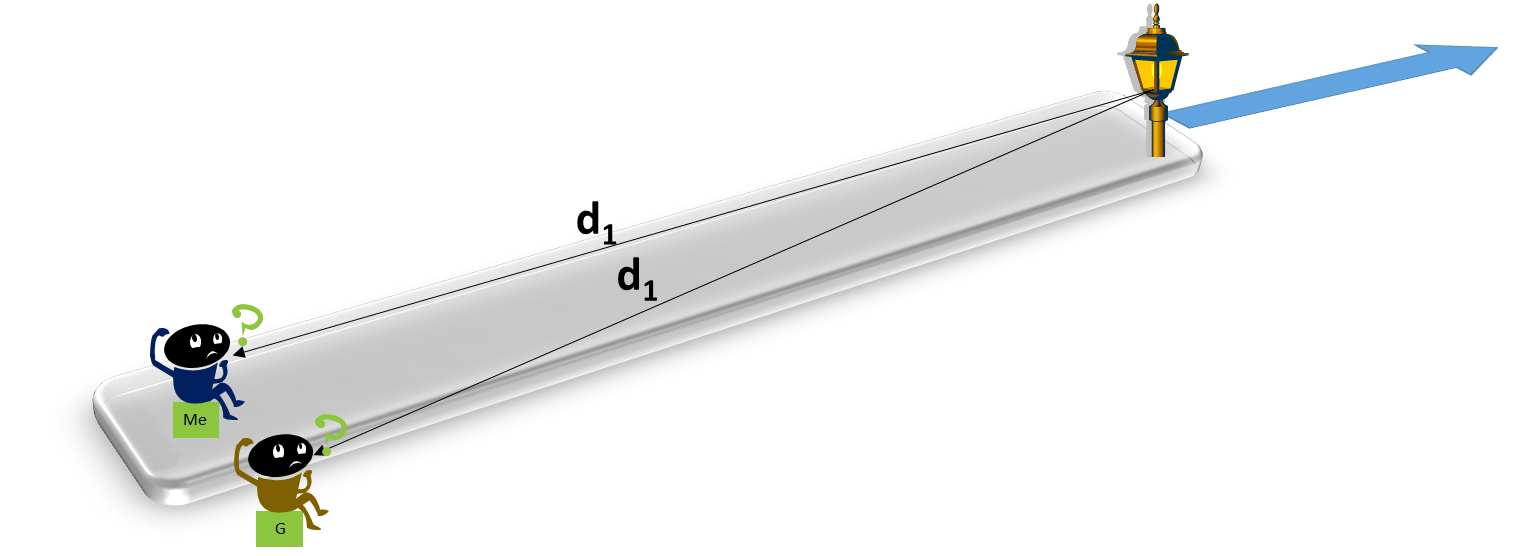
OK, let’s get back to the example from my previous post with me and Greg having fun with relative motion. Here we are again (I’m the one in amazing blue colors), but this time I’m moving in opposite direction: towards the light source.  Alternatively, you can imagine that I’m going in the same direction but the light is on the opposite side of me. I’m just saying this, so you don’t bug me with stupid statements like: “it’s different because you’re moving in different direction”.

LTTT_Pic3

Now, from Greg’s point of view, the light reaches me before it reaches Greg, like this:

LTTT_Pic4

Again, like I explained in the previous post, due to the relativity principle, for each of us, it takes the light the same time to reach us: d1/C. One more time: from my point of view the light reaches me in d1/C, because the light source and I are in the same Inertial Frame of reference (see my previous post on this), but from Greg’s point of view, the light reaches me within: d2/C, so from Greg’s point of view my time is faster than Greg’s time. Let’s pause here, take a breather, relax… Done? Good. Now, remember that, in my previous post, following similar line of thought we discovered that (again from Greg’s point of view) my time (d2/C, or what we called: t2) was slower than Greg’s time (t2 > t1), now, by moving the light source on the opposite side of me, we discovered that my time is faster than Greg’s time (t2<t1).

I hope you’re not imagining that moving the light source from one end of the platform to the other can actually change the flow of time in this manner; if you do, just let me know, and I, just for you, will install two light sources on both sides of me, then I’ll move by my friend Greg, sitting on that stupid square, one more time. However you think about it, it turns out that my time is both: slower and faster than Greg’s, from Greg’s point of view. And before you start criticizing Greg’s point of view, remember that he lives in a free country (I’m not gonna tell you which country it is though) and has the right for his own point of view protected by that country’s constitution. And, as a matter of fact, my time will be both faster and slower than Greg’s from any point of view, if we properly apply this logic, but I really don’t want to rat-hole on this now.

So, in summary, we discovered that the Einstein’s relativity theory leads to the following inequality: t2 < t1 < t2, which you can use to instantly freak out any mathematician you don’t particularly like. And note, that, unlike the tween paradox, you can’t speculate that my direction and/or speed have changed during the experiment.

As much as I admire my newly discovered inequality, I like the equality: t2=t1=t2 (don’t ask me why I wrote t2 twice) better, mostly because it is, actually, possible. I think, if we are able to compare our watches without breaking that uniform relative motion, say: by bending the space or something, our watches would show the same time, unless these are bad, low quality watches, or the batteries are old, or we hadn’t synchronize them before the experiment, or hundreds of other possible reasons with the exception of one: time dilation.

APPLY THE SAME LOGIC AT WILL, IT”S FREE

You can (or, at least I can) use similar logic to show contradictions in any other illustration of the relativity theory. As an example, let’s pick another quite popular one. It goes like this: suppose that the light source (A) is attached to the moving platform, like before, but this time, the light is emitted upwards (perpendicular to the motion of the platform), reflected from the mirror (B) back to the light source. Sorry for a less entertaining picture, I got lazy this time. Just imagine me sitting there next to the little triangle and scratching my head. If this doesn’t work for you, let me know and I’ll draw you a pretty picture and decorate it with little red roses.

IFR, on the pictures, stands for: Inertial Frame of Reference. I am in IFR-1 and Greg is in IFR-2, but if it confuses you in any way, just ignore IFRs altogether, I’ll call it: “my world” and “Greg’s world” for your enjoyment.

LTTT_2_Pic1-1However, because the platform is moving, imaginary Greg, will see something like this:

LTTT_2_Pic1-2

The relativistic line of thought is quite similar to the previous example: since, from Greg’s point of view, the light travels longer distance, but the speed of light is the same from both: my and Greg’s perspective, the time must be flowing slower in my world, than in Greg’s world, again, from Greg’s point of view… Wouldn’t it be better if he hadn’t any point of view at all? For that matter: the only point of view I really care about is mine. But I digress.

OK, now, let’s destroy this fragile logic with the power of my counter-example: suppose there is one more light source on the platform, which emits light at an angle, equal to the angle C in the picture above. You should have guessed the outcome by now: for me and Greg, the light trajectories will look like on the picture below, respectively.

LTTT_2_Pic2Now, the roles have changed and the beam travels shorter distance for me than for Greg. This, according to relativity addicts, would imply that the time is faster in my world, and we’re back to the same paradox, namely that time in my world may be, at the same time, slower and faster, than in Greg’s world.

So, you would ask: if there is no relativity, how would the light behave in the presence of a propagation medium like ether (we agreed to call that medium ether or aether for now, but you may call it whatever you want: photon field, Higgs field, dark matter, I don’t care)? Well, in that case, the light will propagate with the speed of light (no pan intended) relative to the ether and so Gerg will see something like this:LTTT_2_Pic3

Let’s remember this prediction of mine: we may get back to it in one of my future posts that will discuss an alternative to  M&M’s Experiment approach to more definitively answer the question about existence of ether. Which reminds me: in the next post, I’ll provide my explanation of the results observed by M&M. Until then, I do appreciate any constructive feedback accompanied by scientifically valid argumentation.

Check out my next post: Listen to The Thunder (Part 3).

Listen to The Thunder (Part 1)

When you’re dropping rocks in the pool, you should watch the circles on the water, otherwise, you’re just wasting your time.

Kozma Prutkov

PREFACE

This post is 40 years overdue, that’s how long it took me to find courage and write about physics, in other words: about things I’m not supposed to understand (being a software engineer). And perhaps I don’t, but I’m still in a blissful ignorance about that. I guess it’s about time for somebody (preferably a physicist), tell me off and point me to my rightful place in an office cubicle (I’m kidding: I have a personal office) and, at least 100 miles away from the nearest telescope.

It’s not like they didn’t try before: I shared my amateurish thoughts with several Physics PhD dudes, hoping for an instant revelation of my stupidity, but, regretfully, most of the time their telling me off sounded something like: “There must be an explanation, but I don’t remember it now, go read this”. I read this, and I read that, and more I read, stronger was my feeling that those who may be able to point me to my mistakes are locked somewhere in a government secret facility and are banned from communicating with the outside world. Hopefully, these several posts will reveal the last few who are still at large (just doing my duty: helping government to get the bastards 🙂 ).

Of course, the other possibility is that I’m right, however impossible it may sound, which means that lots of theories developed after the famous (or, perhaps, infamous) Michelson–Morley experiment will need to be revised.

OK, I know what you think: “Oh please, not again: not another anti-relativity freak. M&M (that’s how I want to call Michelson and Morley, hopefully, I don’t infringe on any trademarks here) experiment has been verified million times already, there are experiments that clearly demonstrated the evidence of the time dilation (I’ll explain what it is later), everything seems to fit so nicely into the framework, give us finally a brake, will you?”. Well, I’m not so sure about: “nicely fit” aspect of it, but, essentially, you would be right: I am going to, among other things, deal with Special Theory of Relativity (you’ll see me calling it “the theory” “relativity”, “Einstein’s theory” and bunch of other things, hopefully you’ll know what I’m talking about ; if not: give me a call), but I’ll first present the history and the gist of it (that’s what this first post will be about), and then, in future posts I promise to address all your concerns, namely: why I think that the relativity theory can’t be valid, why the M&M and similar experiments produced “unexpected” results, why the “evidence of time dilation” has nothing to do with time dilation, and, depending on how long I can keep writing, some other aspects of scientific speculation.

What I’m NOT going to do is: explain why it is called “Listen to Thunder” pretending there is some mystery in it; at least, not in this first post.

We’ll start looking into Einstein’s Special Theory of Relativity (there is also a General Theory of Relativity, which is even weirder, but somehow makes a bit more sense than special one. We may or may not address it later.), but before explaining the theory itself, let’s first understand why would anybody come up with the weird ideas like: when I move relative to my friend Greg, to him my watch ticks slower than his, but, what’s even weirder: to me, Greg’s time clicks slower than mine, and, according to scientists, there is no contradiction (aka: twin paradox), since there is no way to verify that. Actually, they say, that if we meet again to compare our watches, we may not see any difference, because, in order to meet again, we would need to change the direction and speed and then: gotcha! we broke the rule of being a so-called: Inertial Frame of Reference (in simpler terms: moving with a uniform speed, in a straight line), and so: “Nah-nah-nah-nah: you can’t prove there is any contradiction”. I wonder, what will be the “scientific” explanation if we manage to bend the space (perfectly possible as an inference from the generalization of the same theory) and meet while still moving in the same speed and direction…

Sure, let’s go with that, but wait… how about that evidence for time dilation when atomic clocks from fast moving airplanes were compared and the time difference was “just as the relativity theory has predicted”? It’s easy to show that whatever the movements and speed of dude A is relative to dude B, exactly the same movements and speed (though in opposite direction) would be of dude B relative to A. I do have a better explanation for the time difference they observed, but we’ll save it for later. Right now, let’s talk about the time when the world was much simpler place and time, distance and mass didn’t depend on speed or gravity.

SOME HISTORY

I must note here, that, any decent, self-respecting scientist, would never use a layman words like: “speed” in a serious paper. A failure to use the only proper scientific term: “velocity” could get you forever banished from the scientific society. But, since what I’m writing here can’t be considered a serious scientific paper, and I’m definitely not a decent, self-respecting scientists by any measure, and, after this post, I will, of course, be banished from scientific society anyway, I’ll just completely disregard all this formality and, in general, do whatever I want here.

But I digress… Where were we? Oh yes: good old times. By the last decade of 19th century, the world was totally awesome. Everything made sense and people were reasonable. Nobody rushed anywhere and everybody had plenty of time. Well, with the exception of the factory workers who worked 16 hours a day, but they should blame themselves: they should have learned to add and subtract numbers and become scientists. So, where was I? Oh, yeah: that was the golden age for scientists. First of all, in most places they weren’t burned at stake for their ideas anymore, and they didn’t have spreadsheets or calculators. Stress at work was like: “here, you need to add these 100 numbers together, remember we’re on tight schedule and I need the answer in three months max, can’t wait any longer than that. If you can’t do that you should tell me now.” That would generally leave some time for peaceful contemplation.

The scientific research was about to end: everything was known, all laws of nature were discovered and the scientists were finishing the last chapter in the book of science. Well there were like couple of exceptions, some minor things, which were also known, just needed a bit more evidence. Like this one called: luminiferous aether. You see, the visible light, was behaving exactly like any other known wave, such as, for example sound waves or waves on the surface of water. The waves propagate through media: for sound it’s the matter, pretty much any matter which has those atoms and molecules in it. The sound source pushes some molecules, which, in turn. push nearby molecules, which push their neighbors, etc, until all these pushing around reaches your ear and pushes a sensitive membrane there which your brain interprets as sound.

Water waves need water, gravity and somebody like me who loves throwing rocks into the water. Well, pretty much anything that pushes the water, would work. With water, the pushing around is very much like with sound, but it happens mostly in vertical direction. If you push down at water (you can safely try this at home), the displaced water will displace water around it, which will go up, then pulled down by the gravity, displacing more water around it, etc.

Since 17th century, scientists were finding more and more properties of light, which were so similar to other waves, so, scientists very much agreed that light is a wave too. Now, all waves need a propagation media, in other words: particles that push or pull each other in some way, and so it was concluded that the entire universe is filled with substance scientists call luminiferous aether, and I’m going to call it just ether to save you from the pain of mentally pronouncing: “luminiferous” every time (but, in truth, saving myself from the pain of copy/pasting it over and over again).

And so, in 1887,  Albert A. Michelson and Edward W. Morley (M&M, remember?) conducted an experiment to find the evidence for the ether. Their logic went like this: since the earth is moving through the space (read: ether) at a high speed, and the speed of light is constant relative to the ether, then, relative to earth, the light should go with the speed adjusted by the speed of earth relative to ether. For example: if the beam of light is send opposite to the earth’s movement, it’s speed relative to earth would be faster than if the beam were traveling in the same direction with earth. It’s like you’re riding a train and see a bird flying outside; if it flies in the opposite direction (which, by the way rarely happens: those birds seem to always chose to fly with the train and at the same speed, perhaps hoping to get food or something), it would seem to go by so fast you’d hardly notice, whereas, if they fly with the train, you may be enjoying bird’s company for a while. Of course, for best analogy we should have assumed that the train moves a bit faster (or slower) than the bird, which rarely happens, so, I guess my example sucks in that way, but you get the point, right?

In reality, of course the direction and the speed of the earth is a bit tricky subject. Consider this:

  1. If you’re standing at the equator, your speed due to earth’s rotation is about: 1000 miles per hour
  2. Earth’s moving around the sun with the approximate speed of: 67,000 m/h
  3. With solar system, around the galaxy: ~490,000 m/h
  4. Galaxy moves towards something scientists call: “Great Attractor” (dunno what it is, and it doesn’t matter…) with the speed of about: 2,227,273 m/h

M&M didn’t really know all of that (I mean: they knew some of that, but not ALL of that), and they didn’t care either. They built a contraption, which basically split a beam of light into two beams, and redirected them in a way that they traveled perpendicular to each other (if you don’t know what ‘perpendicular’ means, stop reading right now: the cows need to be milked and the football game is about to start). They made it such, that they could rotate the device whenever they want and make measurements in any and all orientations of the device, and so they believed that they had to observe some difference in the speed of these light beams in, at least, some positions of the device… Actually, that thing they built was floating in a pool filled with mercury for smooth rotation. I always wandered if either of M’s suffered from Mercury poisonous vapors afterwards, but never cared to confirm…

Sufficient to say that, if they would find the evidence of the ether, the Special Theory of Relativity wouldn’t exist and I wouldn’t spend time right now in the search of words to describe it. But, whatever they did, the difference they were looking for was much smaller than what their calculations have predicted.

M&M really freaked out, texted all their friends and family, posted results on the Facebook and received few thousand ‘likes’ in the matter of hours. Scientific community scratched their heads trying to find a good explanation. But no matter what theory they would come up with, it didn’t explain all the known observations, that is: up until Einstein came up with his relativity thing.

So, to summarize: light moves through ether and by ether. However, regardless of the speed with which the light source and the observer move through the ether, the time it takes for the light to reach the observer doesn’t change, it’s like the ether moves with the earth, which is, by the way, one very popular theory (called: drag hypothesis) attempting to explain the M&M results. We’ll come back to it later. For now, let’s just say that, there were some observations which didn’t seat well with the drag theory, and so the supporters of the hypothesis had to eventually shut up.

EINSTEIN AND HIS GREAT ENTRANCE

Then there comes that Einstein guy and says: there is no ether. And, if there is no ether, how do you know if earth is moving? Maybe earth is still, and the rest of the universe is moving around us and in all other directions I listed above? Hmm… isn’t that what everyone was saying before Galileo came along with his rotating earth nonsense? OK, let’s not get carried away here: Einstein didn’t say Galileo was wrong, as a matter of fact he employed Galileo’s principal of relativity to explain the behavior of light observed by M&M.

Here’s the gist of what Galileo was saying about relativity: suppose you’re in a train, which moves with constant speed and in a straight line (something he called: Inertial Frame of Reference, or IFR). And, just to make it more illustrative, suppose the windows are closed and you can’t see outside. Galileo claims, that there is no way you can determine if you’re moving or standing still: everything within the room will behave exactly the same as if you were not moving relative to the earth. Now, even, if you open the windows, you may think the world is moving and not you. Einstein claimed that the light is no different: in any IFR (let’s call it a train or a moving platform, I don’t want to freak you out) it behaves like the train is not moving… But here’s the catch: in Galileo’s world, whatever was happening in that train we mentioned, from outside world would look quite different, than from the seat in the business class attached to the train (now, let’s assume the train is made of transparent glass and, outsiders can see what’s going on inside… Why don’t we make trains like that really?  Wouldn’t it be cool? And imagine how much our kids could learn about physics? OK, I suppose not, but it’ll still be cool). Where was I? Oh yes: looking from outside, everything that moves inside our transparent train will move with the speed, which is the sum of the train’s speed and its speed relative to the train. With light, it’s quite different though: it’s been observed before that the light emitted from a moving object has the same speed as from stationary object (all of this relative to a stationary observer, which is a relative notion by itself, blah, blah, blah… I’m not going to explain all of this using mathematically precise “scientific” language, or I may bore you to death, if I haven’t done it yet…). Moreover, according to Einstein’s theory, the speed of light relative to any IFR (grrr.. can’t avoid it, can I?) is the same and nothing in the universe can move faster than the light in vacuum. That created rather paradoxical situation, which I decided to explain with an example (it’s my blog, I do whatever I want here, ok?).

OK, suppose there are: my friend Greg and I, and I’m sitting on a moving platform. To keep things simple, just assume for now that, in my examples, whenever I say anything about motion or lack of it, it’s all relative to the earth. This just to calm down all those pedantic “precise language” maniacs…

Anyway, here we are on the picture (I’m in dark blue overalls):

LTTT_Pic1

Aren’t we cute? I think Greg has no sense of fashion: all these tasteless colors, you know… And that cube with the pretentious letter “G”, like he couldn’t just write his name. Sometimes, he just drives me crazy!

Yes, about the light. Suppose that light on the moving platform, when it turns on, it is at the equal distance (oversimplification: the relativity would make the distances and things happening “at the same time” also speed-dependent, but this doesn’t change the essence of the illustration and conclusions) from each of us, like on that picture above, but I’m moving, while Greg is not. Now, according to Einstein, the light will reach me in the same time, as if the platform wasn’t moving at all, however, from Greg’s point of view the light reaches him before it reaches me, since while the light was traveling from that lantern to him, I have already moved a bit further, like on this picture:

LTTT_Pic2

Now, as I mentioned above, it was known that the speed of light is the same whether it is emitted from a moving or stationary source (just the frequency changes, also known as Doppler Effect), which means that, to Greg, the light reaches him in the same time as, to me, it reaches me.

OK, this is the most important part, so I’ll say it again: if I had a super-precise watch and had some magical way of timing the time it takes the light to reach me after the lantern goes on, it would take the light some time, let’s call it: “t1” (also known as: d1/C, where ‘C’ is the speed of light, but it’s unimportant). If Gerg measures the time light takes to reach him in the same way using some magic and his super-precise watch, his measurement will, according to Einstein, show the exact same time: “t1”.

Now, Einstein got all excited and also posted his ideas on the Facebook, which caused some of his more intelligent friends and fans to think he’s lost his marbles, and few more inquisitive ones replied to Einsteins post saying something along the lines: “No ether? Fine, good riddance, but great Einstein, aren’t you missing the fact that to the moving guy (that’s what they were calling me in those times: “the moving guy”), the light actually travels a longer distance (d2), if it reaches him in the same time, are you suggesting that the light travels faster than the speed of light?” Einstein, scratched his head for few minutes, but he wasn’t the guy to be defeated that easily, his next post went something like this: “no, the speed of light is the same, but the TIME for the moving guy flows slower…” So, in other words: while for me (the moving guy, remember?) it took light t1 to reach me, from Greg’s point of view, it took a bit longer: d2/C, to be more precise. Let’ call that t2.

Cool right? And a great name for the phenomena: “time dilation”, wouldn’t hurt either. Well, it would be cool, if it hadn’t introduced worse problems than it was intended to solve. But, I’ll talk about those in my next post on this topic.