I have had my results for a long time: but I do not yet know how I am to arrive at them.
THERE HAS TO BE ANOTHER EXPLANATION…
As we’ve seen (or, at least, I’ve seen, not sure about you, folks) in my previous posts (especially part 1 and part 2 of this monologue, pretentiously called: “Listen to The Thunder”) the special theory of relativity presents some, obvious to my amateur logic, contradictions. In other words it can’t be true. Which means that the M&M (no, it’s not a candy: read my previous posts) experiment MUST have a different explanation, as well as the rest of “evidences” of time dilation. I’ll talk about these ‘evidences’ later in this or later posts.
I must confess that when I started with my first post on this topic I thought I had a good explanation of what the monocled men couldn’t explain more than 100 years ago and had to do with things scientists call ‘refraction’, or variation of the speed of a wave through media, which is dependent on the wavelength, and since earth moves with an incredible speed through the ether, the light beams from the M&M experiment going in orthogonal directions will have different wavelength due to the Doppler shift, etc. I liked this explanation because, as I thought, nobody thought about this before (at least that was my illusion). You may actually see how this thought also came after listening to the thunder, but it’s unimportant now since I had an enlightenment afterwards, noticing that if there is any difference in speed due to refraction, it will actually work in the direction opposite to what could embarrass the scientific world. And, of course, embarrassing the scientific world is a goal worth living for…
Anyway, I might have avoided embarrassing myself for the time being, but, of course, if one explanation is wrong there must be one or more other explanations which are right, or else this freaking universe has no idea what it’s doing and needs to make up its mind at some point.
There were quite a few attempts at finding more sensible explanation to the M&M measurements, I’m not the only one who noticed certain problems with relativity. One of more interesting alternative (to relativity) ideas, which stick with the notion of ether (this has nothing to do with the book of Mormon, by the way) or æther as the scientists would put it, was the Ether Drag Theory. To be more specific: the gravitational drag theory, because there is also the, for the lack of official term: “matter” drag theory ( hey there, well educated scientists: feel free to grumble about incorrect terminology. You’re welcome.), which predicts that the ether can be dragged by moving matter. There were some dudes, like this guy or this other guy who thought that the ether is somehow entrapped in the matter and, if the matter (say, air or water) move (say, with the earth), the ether moves with it. If that was the case, the M&M experiment results would have been quite expected, since if the ether moves with the earth, then there is no “ether wind” and the light should move with the same speed in all directions, as long as it’s not leaving the atmosphere. However, an earlier experiments (like this one), showed that ether is being only partially ‘dragged’ by matter. So, the purely matter dragging was quickly ruled out.
In contrast, the gravitational drag theory suggests that only a really big chunks of matter (like earth) with strong gravitational pull are able to drag the ether with it in any significant measure. This definitely sits better with both M&M and Fizeau (the guy who disappointed matter-dragging-lover bunch) experiments. This could have been a happy ending for this whole thing, but no: surely enough party-poopers came along to mess things up again. Their argument sounded like: “Stellar Aberration“, good luck reading this one.
STELLAR WHAT?
Let me try to explain (brace yourselves this might be a bit confusing): once upon a time (in 17th century to be more precise) somebody noticed that the polar star is observed at different angles in different times of the year. The difference was pretty small (40”), but the scientific world (though at that time they were called a bunch of weirdos without any sense of style) demanded some kind of explanation. Luckily, the heliocentric theory (in other words: the idea that the sun is in the center of the solar system and we’re happily revolving around it) was the biggest fad at the time, and the first thing the weirdos thought was: aha! here’s the evidence that the earth rotates around the sun, and so we see the stars under different angles depending on where we are in our orbit, or what the weirdos would call: parallax, just because it sounded so cool (though in Greek it simply means something like “change”).
The bunch-wide celebrations, however, came quickly to a halt, when somebody realized that the angle deviation appeared to be too big to be explained by parallax. The stars are simply too far away for the earth annual wandering to make that much difference in the angle of observation. This puzzled those who were still interested until, some 50 years later the guy named Bradley came up with the theory of, you guessed it: Stellar Aberration, which scientifically speaking, is defined as: “the light does the same thing the rain does when you run though it: it starts hitting you at an angle”. This may sound ridiculous, but the idea has its merits. Let me first try to illustrate to you how this may make sense, before telling you why some people think it’s a bad news for the Gravitational Drag Theory.
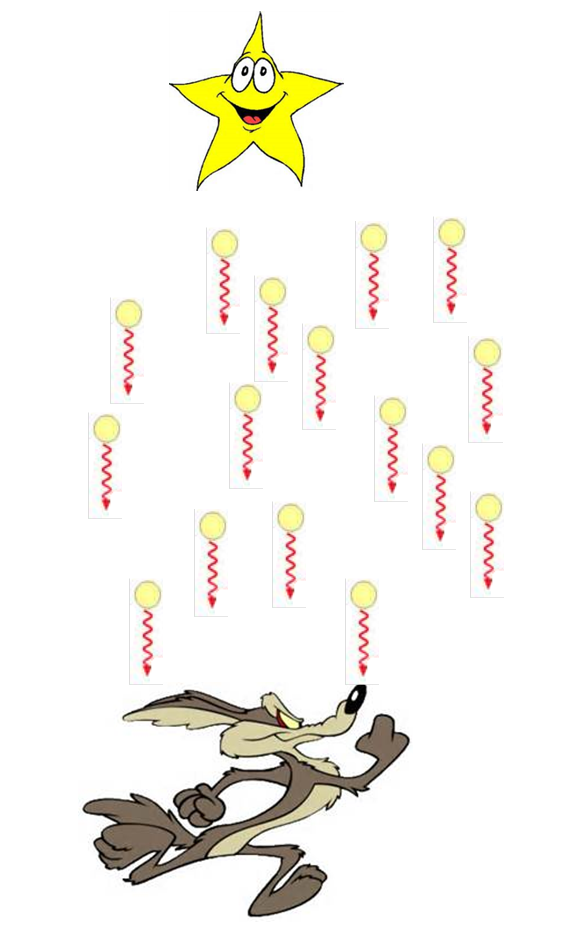
OK, suppose that the light is a flow of tiny particles, called photons, just like rain is a flow of water drops. This may be a big simplification (or even untrue, which might be a good subject for a separate blog post) but it’s a good way of explaining stellar aberration… God! the word ‘stellar’ makes it sound like something the light must be really proud of… Anyway, imagine that the photon rain is produced by a star, far, far away, and, at the moment, located directly above your head, falls down on you, which means that, if you were not moving, you would see the star where it was when it emitted that light thousands of years ago (or perhaps millions or even billions years ago, especially if it’s not a star but a galaxy, which may look like a star to you, but that’s just because you don’t ware radio telescopes for glasses), that is: directly above your head. The star, or the galaxy may not even exist by now swallowed by a black hole or annihilated by some very advanced, intelligent, but apparently uncivilized life form, but we, in our happy oblivion will continue to see it’s light for many years to come.
Now, suppose, that you are moving in the direction orthogonal to the line connecting your head with the star’s location, when it was still alive that is, just like on the picture below.

Actually, that’s how it looks like for a side and stationary observer. What would you (in case you are not a coyote, feel free to replace the picture with your favorite representation of yourself. I don’t know who’s reading this, so I had to make some assumptions…)… what was I saying? Oh yes: what would you see, when you’re moving really fast (in reality you are not moving that fast, it’s the earth moving, of course), according to aberration proponents, would be something like this:

That’s because you are moving and photons are hitting you at a certain angle, just like rain drops. So, you would see the star appearing slightly shifted (right where I produced the gray star for your enjoyment) in the direction of your movement. Like I said, this is an oversimplified way of looking at how light works, but you get the idea.
Now, that we are well versed in the aberration thing, let’s see how it may be related to the Drag Hypothesis. Well, they (the weirdos, remember?) say, that, if the ether were actually dragged with the earth, the photons would stop falling at an angle and start falling again straight down like in the first picture, and there will be no aberration to be observed from the earth surface. That’s where I must stop and say: “what?”, and: “why?” Why would the wave do that? Why would it change it’s direction and all of a sudden start moving orthogonal to the direction in which the earth and the ether around are moving? That’s not what waves do, it’s like throwing a rock to a river, and the produced waves suddenly change their direction, break their favorite circle formations and start moving across the river in straight lines. If you don’t find this thought ridiculous, just try throwing rocks to the running water and watch (and don’t forget to think). Yeah, the waves will move with the water but they are not going to change their direction in such an arbitrary way. As a matter of fact, the moving ether may increase the aberration effect, actually ether may be the real cause for most of the observed aberration. It’s just like looking at the glass of water with a straw or a spoon in it: it looks like the straw is broken at strange angle. I may dedicate a separate post illustrating that the mechanism of such refraction is very similar to what would happen if the light hits a layer of ether moving at angle to the direction of light. Just trust me on this. In any case there is no freaking reason why the light would suddenly move in some specific and arbitrary direction, especially if the moving ether layer hits it in opposite directions at different times of the year.
I don’t know if I’m popping your bubble, but I don’t see the aberration disappearing with moving ether. If anything, the opposite must be true. And, even the light particles (photons) themselves wouldn’t immediately decide to change their direction either, they don’t seem to react that much flying through unimaginable distances through the space filled with infinity of photons emanated from billions of other sources and moving in all directions (I’ll save my rant about the duality of light for some other blog post).
You know, some people like to make too many assumptions about the properties of something they don’t even believe exists. it’s just like refusing that the newly discovered flying and fire breathing lizard may be called a dragon, because the dragons must have blue smoke coming out of their nostrils and be fluent in mandarin Chinese. But I digress… So, if, close to the earth’s surface, the ether moves with the earth, the light radiating from a source that also moves in the same company will behave exactly as if nothing (except for the light waves, of course) moves at all. Thus: the M&M experiment is explained and the relativity theory is done for.
Well… almost. As I mentioned before, there is a collection of other “evidences” of relativity, which are much easier to dismiss, but this blog post is becoming too long and, I’m afraid, even the most devoted readers may give up; so, I’ll come back to these so-called evidences in later posts on this topic.
Adiós for now.
 Armen' s Random Thoughts